


There are some stories out there that end with the death of their protagonist. But sometimes, that’s the starting point. Most of the time, if we’re starting with the death of the protagonist, we’ll be watching some flashbacks to episodes before that. The Rains Came Down isn’t like that – it really uses that death as a starting point, because the story is about what comes after. In more than one sense.
There’s actually a famous historical example in literature that could be applied here: Dante Alighieri, who – in his divine comedy – reports about his death (or not death, in Dante’s case, it’s made to look like he took a wrong turn while strolling around) and his visit to purgatory. Oh, and his visit to the heavens, afterwards, but no one really cares about that part. Dante’s description of purgatory and inferno, his 9 circles of hell, on the other hand, have echoed throughout literature and fiction since he wrote them.
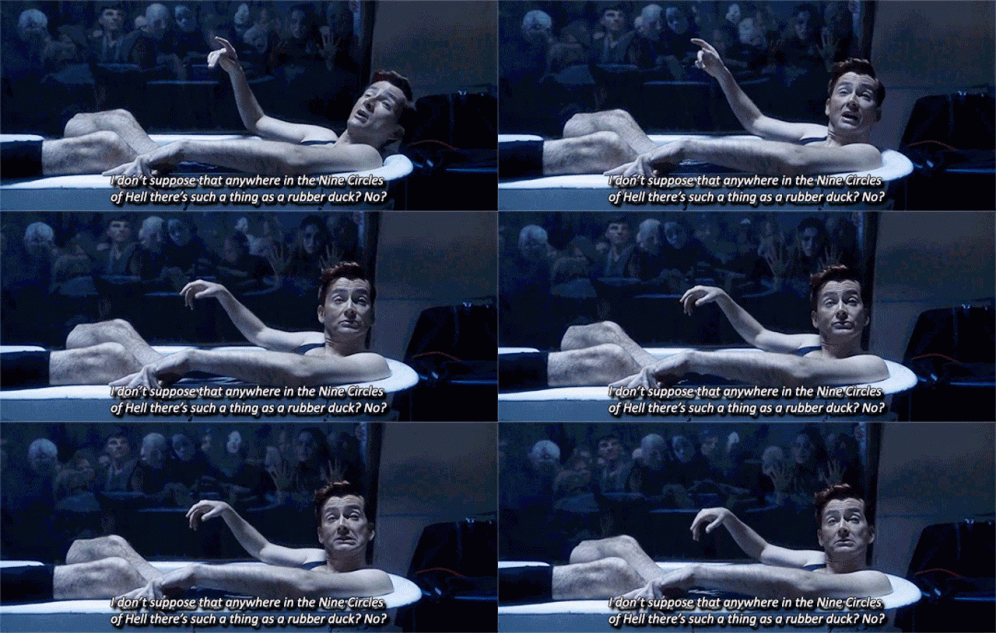
tortures – many
rubber ducks – zero
Gareth is not Dante, not even a poet – he’s just a young man with social anxiety and a small death problem, trapped in a realm that is not called Purgatory, but Penitence by those who run the place. And the powers that be – whatever they might be – use those freshly dead people to confess their sins, thereby drawing out the darkness from them, collecting it like a resource.
That darkness is used in the creation of glass marbles, because redeeming your sins in Penitence consists not only of confessing, but also of hard labor. And above every glass kiln, there’s an inscription:
Sweat is debt. Freedom is earned.
I can’t even start to tell you how that did hit me, because it reminded me on one of the darkest hours in modern human history – German concentration camps. I think the photo of the entrance to Auschwitz is world famous (or infamous), portraying the words ARBEIT MACHT FREI (labor sets you free – I like to translate Arbeit in this sentence rather into labor than work, I find the first one a more fitting translation). That sentence over the Auschwitz entrance was a lie, as we all know, and for me, this little piece of information injected a lot of dark foreshadowing into the tale.

That reference was not intended, at least consciously (and I know, because I asked Julian who is a kind soul and did answer me that without spoilering me), but I wanted to let you know anyway before you’re reading this fantastic story. Because intented or not, keep that connection in mind. It sets a great tone for what is to come.
This sounds like a great time to mention that there is also an interview with Julian Shaw for your reading pleasure!
This is furthered by the trains from the Department of Onward Transportation and the fact that people who “die” in this afterlife are brought to a place called “the source”. I think the way you look at stuff like this can change your reading experience: For me, it created a dark atmosphere, giving off some serious soylent green vibes. It didn’t freak out Gareth, but it gave me as the reader the heebie-jeebies. Loved the atmosphere this created.
But all those observations aside, it takes no genius to realize that something in that warehouse, that Penitence, that whole afterlife, doesn’t add up. And of course it doesn’t – but I won’t tell you more here, because spoilers. Duh. I’ve already said enough.
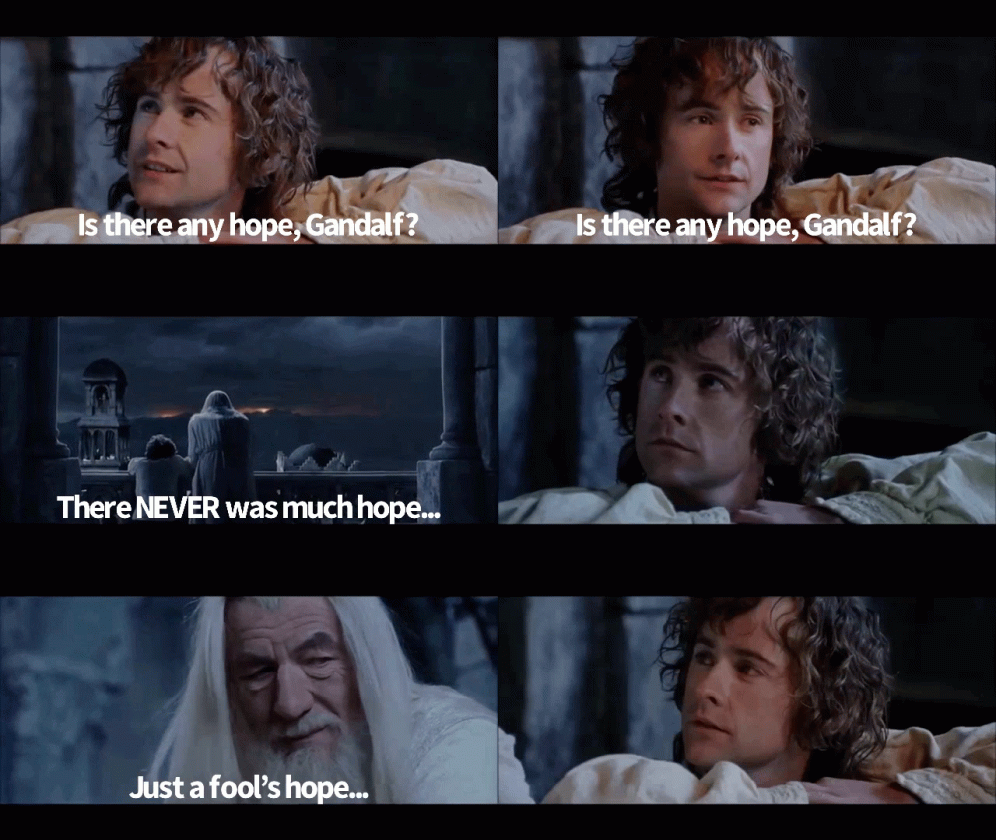
But there are more references in the text, i.e. Virgil College and even Dante College – Virgil was a poet like Dante, long before him, but Dante meets him in inferno in the divine comedy. (In reality, they lived thirteen centuries apart.) And that being said, Dante’s inferno had its own inscription on its entrance: ABANDON HOPE ALL YE WHO ENTER HERE. It would have been a fitting quote in context of this story, as well.
Julian’s world building is kind of dark, gritty, and – to my eye – multilayered. But it’s also fascinating, as it contains loads of references, as you’ve seen. It’s all there for you to conquer and explore for yourself, the religious ridicule, the misogynistic mindsets, the divide between the inhabitants of the meadow. You’ll have to figure it out for yourself, because Julian does no handholding. Which is great in my opinion, but if you expect a fantasy world where everything is spelled out for you, this story is not for you. If you like to make your own discoveries, you’ll love the world of the meadow!
It even has a sacred religious text with a weird name I’m not even remotely able to pronounce – gweirglodd mabinogion – which is probably Welsh for “stories from the meadow”. So, yes, theological stuff is abound. Any devout Christian should be warned, though; some of this stuff might hurt their religious feelings.
I wonder if we would be better seeing beauty, not as a state fragile to being slashed, cut, or broken, but instead, more like flowing water?
Gareth evokes his philosopher’s core
In the end, this story is a journey about many things. It can also be seen as a commentary on society and the injustice within, toxic masculinity, human rights and other stuff. There’s something for everyone!
They say, all’s well that ends well. On that front, there is the one thing I really have to criticize. Yes, the last sentence of this novel is actually quite a good sentence (as last sentences go), but a little more detail on the “what happened after” would have been nice. Then again, it was a very neat way to bring everything together.
My thanks to Julian Shaw for granting me an arc in exchange for my honest review!

 Crossing the Pond Reviews
2 replies on “The Rains Came Down, by Julian Shaw”
[…] Shaw is the author of The Rains Came Down, a novel that is partly social commentary, (spiritual) journey and an invitation to explore what it […]
LikeLike
[…] READ FULL BLOG… […]
LikeLiked by 1 person